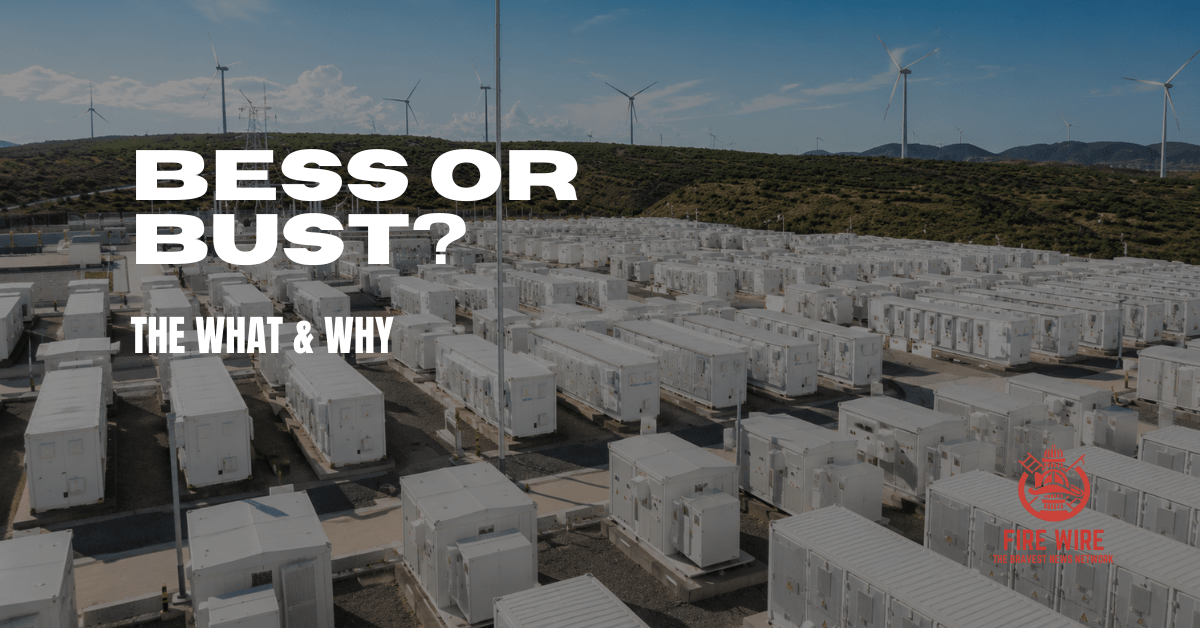
Somewhere in your response area, there’s probably a piece of ground getting cleared for a Battery Energy Storage System, and there’s a good chance nobody from the department has been in the room for it. That’s not a knock on you — it’s on how these projects get pushed through permitting without pulling in the people who’ll actually be standing in front of the thing when it fails. We’re not here to scare you off it or sell you on it. We’re here to tell you what it is, what it does when it goes wrong, and what you need to have squared away before the tones drop.
What you’re actually looking at
A BESS is rows of shipping-container-sized boxes packed with lithium-ion battery racks, sitting there to bank power for the grid so the lights stay on when demand spikes or the wind stops blowing. Some sites are a handful of containers. Some are dozens, spread across acres, tucked next to a substation or a solar field where nobody’s paying much attention until something goes sideways.
Why these things keep getting built — and why that’s not all bad
We’re not going to stand here and tell you these sites are pure liability with no upside, because that’s not straight with you and it’s not true. Here’s what they actually do for the grid and for the towns that host them:
- They keep the lights on when demand spikes. A BESS banks power during off-peak hours and dumps it back into the grid when everybody’s AC kicks on at once. That’s fewer brownouts, fewer rolling blackouts, and less strain on infrastructure you’d otherwise be responding to anyway — a hospital or nursing home losing power is its own kind of call nobody wants.
- They make solar and wind actually usable. The wind doesn’t blow on your schedule and the sun doesn’t shine at 8pm. Storage is what lets renewable power get used later instead of wasted the second it’s generated. Whatever your politics on the energy transition, that’s the engineering problem these sites solve, and it’s a real one.
- They can back up critical infrastructure directly. Some installations are sited specifically to backstop hospitals, water treatment plants, or emergency communications — the same infrastructure your department relies on to do its job during a storm or a grid failure.
- They put money on the table for the host town. Lease payments, PILOT agreements, tax revenue — that’s often what gets these projects approved by a town board in the first place, and it’s frequently money that ends up funding local services, sometimes including the fire department’s own budget. Worth knowing before you write these off as pure downside.
- The failure rate keeps dropping because the money’s forcing it to. Developers and insurers do not want a site that burns down and takes their financing with it. That commercial pressure is a big part of why design and manufacturing standards have actually gotten better, not worse, as these sites multiply.
None of that cancels out what’s in the next section. It just means you’re not fighting a project with no legitimate purpose — you’re making sure a project that’s going to get built anyway gets built with your department in the room. That’s a much stronger position than blanket opposition, and it’s the one that actually gets you a seat at the table when the emergency response plan is being drafted instead of after.
Your problem, regardless of the upside, is still what’s inside those boxes and what it does when it fails.
What it does when it fails
Lithium-ion cells go into thermal runaway — one cell cooks off, it heats the ones next to it, and you get a cascading failure that doesn’t behave like anything else you’ve trained on. A few things you need locked in before you’re standing in front of one, not during size-up:
- You are probably not putting this fire out. These fires resist conventional suppression and can reignite hours or days after everybody thinks it’s handled. They also throw off gases that are a real health hazard to anyone standing near them — command staff, mutual aid, bystanders, all of it. SCBA isn’t a maybe on this one.
- Defensive is the tactic, not a failure to act. EPA guidance on these incidents calls for an isolation zone of at least 330 feet on large commercial sites, staging upwind and uphill, and a real evaluation of whether the surrounding area needs to shelter in place or get out. If your mentality walking in is “knock it down,” recalibrate now. Have that conversation with your crew before this happens, not while it’s happening.
- The numbers are moving in the right direction, and that matters when you’re talking to your town board. Reported failure rates per gigawatt-hour deployed reportedly dropped somewhere around 97% between 2018 and 2023 as manufacturing and design standards caught up. Doesn’t mean these things can’t hurt you. Means the industry got embarrassed enough times to actually fix some of it.
The code just changed. Ask if anyone told your chief.
NFPA 855 updates on a three-year cycle, and the 2026 edition just dropped. Here’s what’s different, and why it’s your business even if you’ll never open the standard yourself:
- Hazard Mitigation Analysis is now the default for nearly every project, not just the ones that crossed some energy threshold like under the old edition. Translation: there’s supposed to be a documented risk analysis on file for these sites now. Ask your AHJ if your department has actually seen it for anything in your district. Don’t assume yes.
- Explosion control got stricter — active prevention systems are required now, and the old vent-and-hope approach is out. That’s a real engineering shift, and it’s the kind of detail worth knowing before you argue with an engineer at a public hearing.
- The standard leans harder on emergency response planning and coordination with the AHJ. If there’s a BESS project moving through permitting anywhere near you, your department has every right to be at that table. Show up. Don’t wait to get invited.
New York specifically
New York’s got more BESS moratoriums than anywhere else in the country — 97 of them and counting — because plenty of towns are pushing back before these things get built. If your municipality is in that fight right now, that’s your window. Use it. Get the emergency response plan written into the approval before the ribbon gets cut, not filed as an afterthought six months after the site’s live and something’s already gone wrong.
Bottom line
These sites aren’t going anywhere. The grid needs them and the money’s too good for that to change. The departments that come out ahead aren’t the ones treating every BESS like a bomb, and they’re not the ones sitting back assuming this is somebody else’s problem. They’re the ones who forced their way into the permitting conversation, got the hazard analysis in hand, and ran the tabletop before the real call came in.
If you’ve already got one of these in your district — built, proposed, whatever stage — tell us how it went, or how the fight’s going. That’s the kind of ground truth that actually helps the next department reading this.
Sources: EPA Office of Resource Conservation and Recovery; NFPA 855 (2026 edition); Energy-Storage.News; Engineering Fire Protection.n.
Find out about all alarms across NYC, Long Island, and beyond – on the minute with the Fire Wire App.
We have also covered incidents across the USA and even internationally! Make the NYC Fire Wire App your go-to for all emergency news. Turn on notifications to hear about incidents on the minute!
DOWNLOAD TODAY!
Select your operating system to download now:
Learn more about the app here.