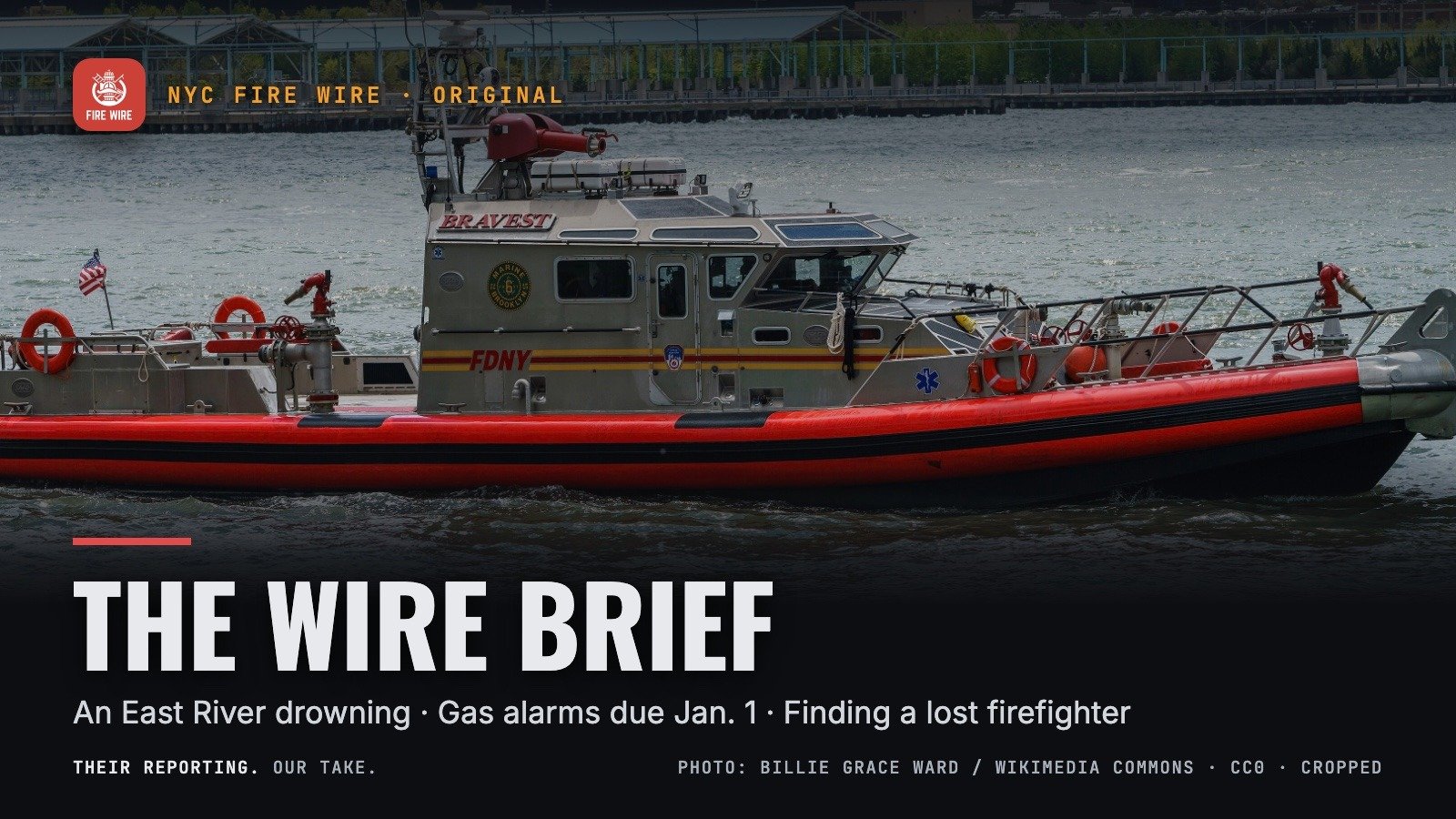
Welcome to the Wire Brief. We pull the stories the job is talking about, send you to the reporters who did the work, and tell you what we think it means when the tones drop. This one covers Thanksgiving week, November 24 to 28.
A man goes into the East River off Long Island City
The call came in just before 11 p.m. on Tuesday, November 24: a person in the water at Gantry Plaza State Park, behind the Hunters Point Library. QNS reports that witnesses saw a 38-year-old man climbing on a pile of rocks at the water’s edge before he slipped and fell in. Officers from the 108th Precinct spotted him in the water just off the rocks. The department sent 17 units to Center Boulevard along with marine units on the river, and FDNY divers brought him out unconscious and unresponsive. EMS performed CPR and took him to NYU Langone Tisch Hospital, where he was pronounced dead. Police had not released his name, and the investigation is continuing.
Fire Wire’s take
Start with the man and whoever is waiting to hear about him. As of the reporting, nobody had put a name to him yet. That is its own kind of hard.
For the job: a person in the water at night is a race against a clock nobody can see. Seventeen units and marine companies for one victim is what that race takes, and the divers went into the East River in late November to finish it. They did their part. The river had a head start.
For everybody else: the rocks along the waterfront are not a path, and they are slick. If you see someone go in, call 911, keep your eyes on the spot where they went under, and point the first rig to it. Do not go in after them. Then there are two.
Gas alarms are due in every home by January 1
Under Local Law 157 of 2016, most residential buildings in the city must have natural gas detectors in place by January 1. QNS reports that the rule covers apartment buildings, private homes including one- and two-family houses, hotels and single-room occupancy buildings, with an alarm in each unit near the gas appliances. Landlords are responsible for providing them in tenants’ apartments. Hard-wired, plug-in and battery-powered alarms all qualify as long as they are listed to UL 1484 or UL 2075. The city and the utilities have been handing out free detectors to small homeowners, first come, first served, and the next Queens event is Saturday, December 5, from 10 a.m. to noon at the Thomas White Jr. Foundation Building in Jamaica.
Fire Wire’s take
This law has been on the books for ten years and the deadline is five weeks out. Most people we know could not tell you whether they have one.
For the job: an alarm that sounds early is a gas run where everybody is already on the sidewalk when the engine pulls up. We will take that over the other kind every time.
For everybody else: a natural gas alarm is its own device. It does not replace the smoke alarm or the carbon monoxide alarm, and they do not replace it. Check the box for one of those two UL numbers before you buy. If it goes off, or you smell gas, do what the city says in the QNS piece: get out first, then call 911 from a safe distance.
A former hazmat chief says a grid battery is not an e-bike
In an opinion piece in the Bronx Times, Daniel Murray, a former FDNY deputy chief in charge of hazmat operations, makes the case that large battery storage sites behave differently from the batteries we write about most weeks. He describes a site as many separate sealed units spaced apart, each built to contain its own failure. Hose streams are not recommended, he writes, because the enclosures keep water away from the cells. Crews secure the area, keep their distance, let the affected unit burn out under monitoring and cool nearby equipment if needed. He writes that each project needs a hazard analysis and an emergency response plan reviewed by the FDNY, and that there has never been a fire at a utility-scale storage project in New York City.
Fire Wire’s take
This is one man’s opinion piece, and we are passing it along as that. Where these sites get built is a fight for the neighborhoods and the people they elected. We are staying out of it.
For the job: the useful part is the tactics. Everything we have learned about the scooter in the hallway says get water on it and get people out. What he describes at a storage site is close to the opposite: perimeter, patience, protect what is next to it. If one of these is going into your first-due, read the response plan before the run, not on the way to it.
One caution of our own. No fire at a site like this in the city also means nobody here has worked one. The batteries that are killing people are still the ones in apartments, and we covered how those behave in Lithium-Ion Fires: What’s Really Going Up in Flames.
We can track a suitcase. We still cannot find a lost firefighter.
Firehouse reports on Find Them Now, a campaign started by a group of fire service leaders to push the federal government and the Federal Communications Commission on indoor tracking for firefighters. The FCC is considering rule changes that would let private companies build it. Former Boston fire commissioner Joseph Finn told Firehouse that today’s location tools are a step in the right direction but are not accurate enough inside a building to find a member in trouble, and that what is needed is a precise position, including the floor. The story walks through the fires behind the campaign: Worcester Cold Storage in 1999, a Phoenix supermarket in 2001 where a lost firefighter could not be found for nearly 15 minutes, and a Boston brownstone basement in 2014.
Fire Wire’s take
The suitcase line is Finn’s, and it is hard to argue with. Read the Never forget section below and you will see how old this problem is.
For the job: we would take this technology tomorrow. Until it shows up on the rig, finding a lost member is still done the hard way, so the answer is not getting lost. Stay oriented, know your second way out before you need it, watch your air, and give the mayday early. Pride has never found anybody.
Home for Thanksgiving
One good one. PIX11, carried by Firefighter Close Calls, reports that an FDNY firefighter who survived a cardiac arrest was discharged from Glen Cove Hospital on Wednesday, November 25, the day before Thanksgiving, after a month-long stay. First responders in Nassau County are credited with saving his life, and many of his colleagues were at the hospital when he was released.
Fire Wire’s take
A month in the hospital and home for the holiday. An ending like that starts with somebody who knew what to do in the first minutes.
For everybody else: you do not need a uniform to be that somebody. Take a CPR class this winter and find out where the nearest defibrillator is at work and at the gym.
Never forget
Two lieutenants, both lost on November 26, both remembered this week by Firefighter Close Calls. In 1957, Lieutenant Richard MacClave of Engine 46 was overcome while searching the fire apartment at a second-alarm tenement fire at 4035 Park Avenue in the Bronx. His company found him unconscious with the facepiece of his filter mask still on. He was 46, a 20-year member, and left a wife and three children. The filter mask had been approved for general firefighting three months earlier. The department later moved to self-contained breathing apparatus, a history we cover in The Development of SCBA. A plaque in his honor hangs in the quarters of Engine 46.
In 1988, Lieutenant Robert H. Dayton Jr. of Flower Hill Hose Company 1 in Port Washington became disoriented and ran out of air while searching the apartments above a burning antique shop at 165 Main Street. He was 28, a ten-year volunteer in the town where he grew up, and since 1985 a member of the FDNY assigned to Engine 287 in Elmhurst. He left a wife and an 11-month-old daughter and was posthumously promoted to captain. Port Washington is building a training center that will carry his name.
Bottom line
A quiet week on paper, and a short list of things that buy time. A gas alarm that sounds before the room fills. A bystander who starts compressions. A mask that works, which cost a lieutenant his life to learn. A way to find a member before the air runs out, which we are still waiting on. Buy the alarm, learn CPR, and stay off the rocks.
The Wire Brief links to original reporting by the outlets named above. Facts are theirs. Opinions are ours and do not represent the FDNY or the City of New York. Got a story we should weigh in on? Send a tip.
Find out about all alarms across NYC, Long Island, and beyond – on the minute with the Fire Wire App.
We have also covered incidents across the USA and even internationally! Make the NYC Fire Wire App your go-to for all emergency news. Turn on notifications to hear about incidents on the minute!
DOWNLOAD TODAY!
Select your operating system to download now:
Learn more about the app here.