NYC FireWire
At a glance · The morning, minute by minute · The response · The losses · Rescue and recovery · The illness that followed · How the department changed · Memorials and where to pay respects · Resources and foundations · More from Fire Wire · Questions and answers
At a glance
Quick facts
- Date: September 11, 2001
- Alarm box: Manhattan Box 5-5-8087, World Trade Center
- FDNY members killed: 343
- FDNY response began: 8:46 a.m., the moment the first plane hit the North Tower
- South Tower collapsed: 9:59 a.m.
- North Tower collapsed: 10:28 a.m.
- 7 World Trade Center collapsed: 5:20 p.m.
- Fire units that responded: more than 200, about half of the department
- People killed in the attacks: 2,977 at the three sites, as counted by the 9/11 Memorial
- Other responders killed in New York: 37 Port Authority police officers and 23 NYPD officers
- Recovery work ended: May 30, 2002
- Members lost to World Trade Center illness since: more than 400, as of September 2025
This page sets out what the department did that day, hour by hour, and what came after. It is built from the 9/11 Commission Report and other official records, all listed at the bottom. The full roll is on its own page: the FDNY 343.
The morning, minute by minute
Times are from the 9/11 Commission Report unless an entry says otherwise. The review McKinsey & Company wrote for the department in 2002 and the federal investigation by the National Institute of Standards and Technology (NIST) fill in the rest.
8:46 a.m.
The first plane and the first alarms
American Airlines Flight 11 hit the North Tower, 1 World Trade Center, between floors 93 and 99.
The chief of Battalion 1 saw it happen from the corner of Church and Lispenard Streets. He transmitted a second alarm at once and a third alarm at 8:48 a.m. while still on the road. Each alarm brings more companies and chiefs. The 9/11 Commission found that the department’s response began within five seconds of the crash.
8:50 a.m.
A command post in the North Tower lobby
The Battalion 1 chief reached the North Tower at about 8:50 a.m. and set up the command post in the lobby. Two engine companies and two ladder companies were there by about 8:52 a.m. The chief of Division 1 arrived minutes later and took command.
Building staff told the chiefs that all 99 elevators appeared to be out and that nobody could promise water on the upper floors. The chiefs decided this was a rescue job, not a firefighting job.
8:57 a.m.
The first companies start up the stairs
One engine company and one ladder company began climbing stairwell C at about 8:57 a.m. as scouts, to get near the fire floors and report back. They worked on tactical channel 1, the portable radio channel companies share at a fire.
By then the chiefs had also asked building staff and a Port Authority police officer to evacuate the South Tower. In their judgment the whole complex was unsafe.
9:00 a.m.
The Chief of Department takes command
The Chief of Department arrived at about 9:00 a.m. Crossing the Brooklyn Bridge on the way in, he and the Chief of Operations called for a fifth alarm and two more rescue companies. He moved the overall command post to the far side of West Street. The lobby stayed open as the operations post for the North Tower.
By 9:00 a.m. the units already sent carried about 235 firefighters: 21 engine companies, nine ladder companies, four rescue companies, two squads and the department’s one hazardous materials company.
9:03 a.m.
The second plane
United Airlines Flight 175 hit the South Tower, 2 World Trade Center, between floors 77 and 85.
The Chief of Department called a second fifth alarm. The Commission places that call right after the impact. The McKinsey review logs it at 9:12 a.m.
9:05 a.m.
The repeater test
The Trade Center had a repeater, equipment that rebroadcasts portable radio signals so they carry through a high-rise. Chiefs in the North Tower lobby tested it at 9:05 a.m. One of two buttons on the console had not been pressed, so the chief on the handset could not transmit. The chiefs took the system to be dead and kept the North Tower on tactical channel 1.
It was working at least in part. Members in the South Tower used it on channel 7.
Companies began climbing stairwell B in the North Tower at about 9:07 a.m., each member carrying about 100 pounds of gear.
9:29 a.m.
Total recall
The Chief of Department ordered a recall of every off-duty firefighter and officer. The order went out over department radio and through the news media. The recall procedure had not been used in more than 30 years.
9:30 a.m.
The first member is lost
The department’s first death of the day came at about 9:30 a.m. near West and Liberty Streets, outside the South Tower. NIST identifies the member as Firefighter Danny Suhr of Engine 216.
Source: NIST NCSTAR 1-8
9:46 a.m.
One more fifth alarm
The Chief of Department called another fifth alarm at 9:46 a.m. At 9:54 a.m. 20 more engine companies and six more ladder companies were sent. With that, more than one third of all the department’s companies had been dispatched to the Trade Center.
9:58 a.m.
The 78th floor of the South Tower
A battalion chief climbing the South Tower reached the 78th floor by stairwell A. He reported that the stairs looked open to the 79th floor, inside the impact zone. NIST’s radio log and roll identify him as Battalion Chief Orio Palmer of Battalion 7.
9:59 a.m.
The South Tower collapses
The South Tower came down at 9:58:59 a.m., in about ten seconds.
Every command post went out of service with it: the overall post on West Street, the North Tower lobby, the Marriott Hotel lobby and the staging area south of Liberty Street. A fireboat on the Hudson reported the collapse on the Manhattan dispatch frequency, but nobody at the scene received it.
Within a minute a chief leaving the North Tower lobby radioed all units in Tower 1 to evacuate. Many members higher up did not hear it, and many did not know the other tower was gone.
10:15 a.m.
The order is repeated from West Street
At about 10:15 a.m. the Chief of Department and the Chief of Safety, back on West Street, confirmed that the South Tower had fallen. The Chief of Department ordered all units out of the North Tower and repeated the order about five times. He had the command post moved north on West Street toward Chambers Street.
10:28 a.m.
The North Tower collapses
The North Tower came down at 10:28:25 a.m. The Chief of Department and many of his senior staff were killed.
Twelve firefighters, one Port Authority police officer and three civilians who were coming down stairwell B lived through the collapse.
11:28 a.m.
Command is put back together
For about an hour after the second collapse command was badly impaired, and several chiefs set up posts on their own. At about 11:28 a.m. a single command post was named at West and Chambers Streets and a citywide tour commander took over as incident commander.
2:30 p.m.
Members are pulled back from 7 World Trade Center
The 47-story building at 7 World Trade Center had been hit by debris from the North Tower. It was burning on at least six floors and there was no water to fight the fires. At about 2:30 p.m. chiefs decided to give the building up and clear the area around it.
Source: NIST NCSTAR 1-8
5:20 p.m.
7 World Trade Center collapses
7 World Trade Center came down at 5:20:52 p.m. after burning for almost seven hours. Nobody was killed. NIST credits the decision, made nearly three hours earlier, to stop all efforts to save the building.
Source: NIST, WTC 7 investigation
The response
The department that morning
The FDNY had about 11,000 members that day, with 205 engine companies, 133 ladder companies, five rescue companies and seven squads. See FDNY units for what each does and FDNY ranks for the chain of command.
Who was sent
More than 200 fire units went to the World Trade Center, about half of all the units in the city. In the first three hours 121 engine companies, 62 ladder companies and 27 chief officers were assigned, along with nearly every special operations unit the department had. More than 100 ambulances responded, about 30 percent of the city’s emergency medical system.
The plane hit just before the 9:00 a.m. change of tours, the shift change, and many members going off duty rode in with the oncoming tour. The McKinsey review found that only four fire units went without being sent by the dispatchers.
Command posts and staging
Command passed in about ten minutes from the Battalion 1 chief to the Division 1 chief, to a citywide tour commander (a staff chief responsible for the whole city on that tour) and then to the Chief of Department. From about 9:00 a.m. the overall command post was on the west side of West Street. Each tower lobby had its own operations post.
Units on the third alarm and above were sent to staging areas, spots near the job where companies wait for orders: West and Vesey Streets, then West and Albany Streets for the South Tower. Many companies went past them and straight to the lobbies. Chiefs lost track of who was where, and some companies from other parts of the city could not tell one tower from the other.
The FDNY was the lead agency. Fire companies took the floors above the ground, and police officers moved people out of the complex at street level.
Senior chiefs and the recall
Of 32 staff chiefs and members of the executive staff, 26 went to the scene and 22 were there before the first collapse.
The recall brought in thousands of off-duty members. The first order did not say where to report, so they went to the scene, to firehouses or to recall points set up later in the morning. Every reserve rig was put in service.
The rest of the city
The dispatchers relocated dozens of companies around the city and kept regular fire coverage in place (see dispatch and relocations). Special operations coverage was very thin, because nearly all of those units were at the Trade Center. The department asked for mutual aid, help from outside departments, from Westchester County at about 10:07 a.m. and from Nassau County at 10:23 a.m.
NIST estimated that between 16,400 and 18,800 civilians were in the complex at 8:46 a.m. The Commission found that the great majority of civilians below the impact floors got out, and that first responders played a significant role in that.
The losses
The FDNY lost 343 members. The 9/11 Commission called it the largest loss of life of any emergency response agency in history.
The U.S. Fire Administration counts 341 of them in the firefighting force, including the department chaplain, and two as paramedics of the Emergency Medical Service. According to NIST, department data shows about 160 of the 343 were lost outside the two towers.
The department’s leaders and the chaplain
Four leaders who responded from headquarters were killed, and the department honors them each year at its headquarters memorial service:
- Chief of Department Peter J. Ganci Jr.
- First Deputy Commissioner William M. Feehan
- Assistant Chief Gerard A. Barbara
- Assistant Chief Donald J. Burns
Father Mychal Judge, the department chaplain, was also killed. He was 68.
By rank
Counted from the department’s own memorial lists, the 343 were:
| Rank or title | Members |
|---|---|
| Firefighters | 249 |
| Lieutenants | 46 |
| Captains | 21 |
| Battalion chiefs | 19 |
| Assistant chiefs | 2 |
| Chief of Department | 1 |
| First Deputy Commissioner | 1 |
| Fire marshal | 1 |
| Chaplain | 1 |
| Paramedics | 2 |
These are the ranks members held that day. About 30 were promoted after their deaths, and the 9/11 Memorial shows the higher rank.
By company
These are the units with seven or more members on the department’s roll:
| Unit | Members lost |
|---|---|
| Ladder 3 | 11 |
| Rescue 1 | 11 |
| Rescue 5 | 11 |
| Squad 1 | 11 |
| Ladder 4 | 8 |
| Ladder 5 | 8 |
| Ladder 15 | 8 |
| Haz-Mat 1 | 7 |
| Ladder 2 | 7 |
| Ladder 20 | 7 |
| Ladder 21 | 7 |
| Ladder 25 | 7 |
| Ladder 101 | 7 |
| Rescue 2 | 7 |
| Rescue 3 | 7 |
| Rescue 4 | 7 |
| Squad 18 | 7 |
All five rescue companies lost members: 43 between them. The squads lost 35.
These totals follow the unit each member is listed under on the department’s memorial pages. Covering officers and detailed members are listed under their assigned unit, so a firehouse’s own count for that morning can be higher.
Every name, with company, is on the FDNY 343. Members lost at other jobs are on our line of duty roll.
Rescue and recovery
Rescue work began at once. The recovery went on for nine months.
The first days
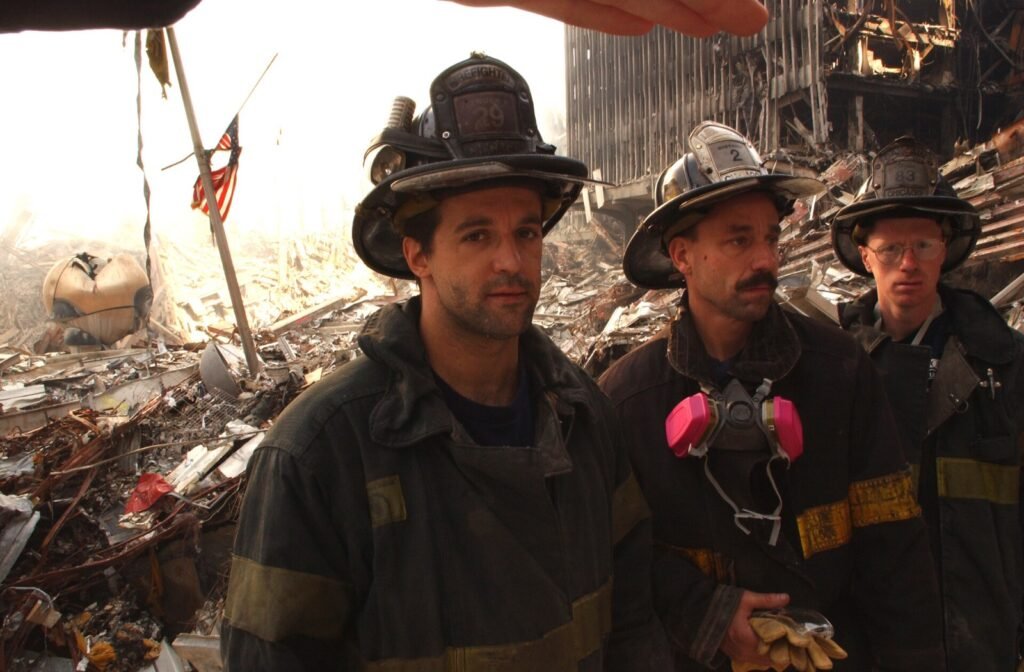
The command post stayed at West and Chambers Streets until about 6:00 p.m. on September 11, then moved to West and Vesey Streets. On the morning of September 15 it moved into the quarters of Engine 10 and Ladder 10 at 124 Liberty Street, across from the site. On September 17 it moved to the larger quarters of Engine 7, Ladder 1 and Battalion 1 at 100 Duane Street.
The city’s emergency management office had asked the Federal Emergency Management Agency for at least five urban search and rescue teams within minutes of the first plane. Federal incident management teams reached the site on September 13 and helped the department with planning, maps and daily action plans.
Nine months
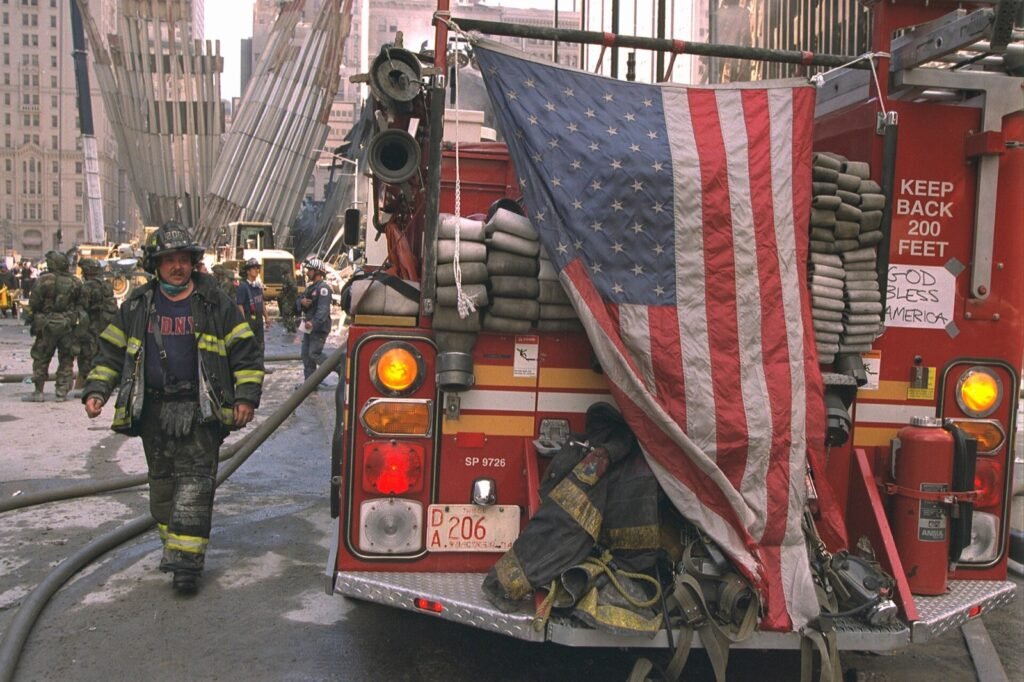
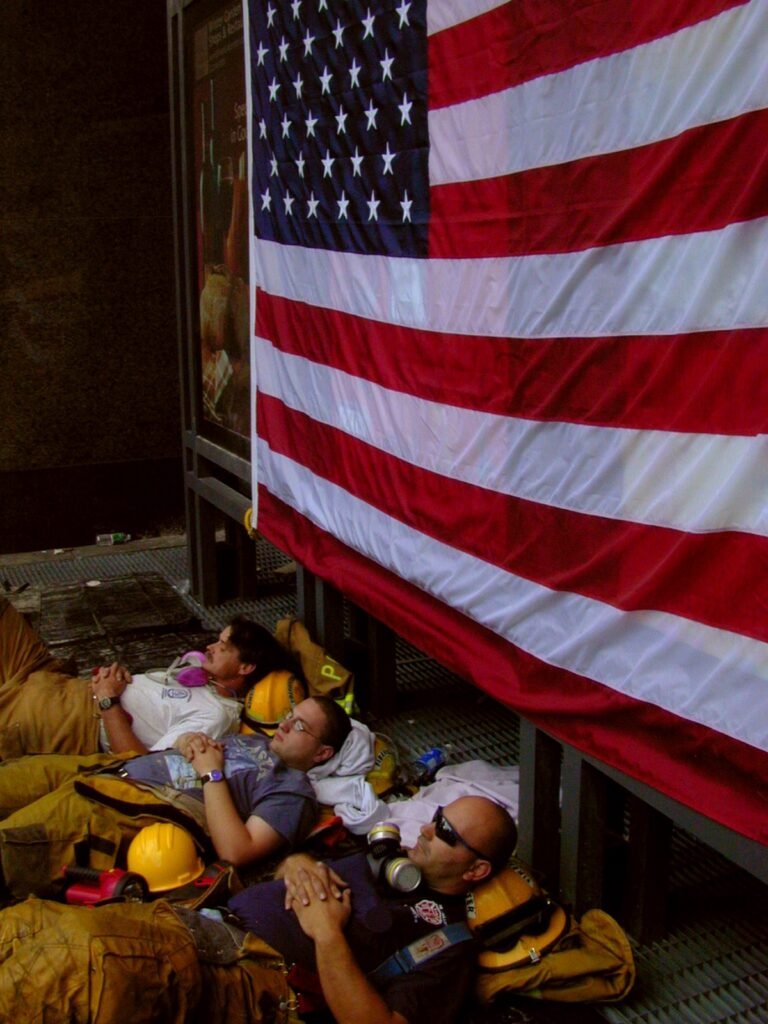
Fires burned in the pile for about 100 days. Tens of thousands of people worked there: firefighters, police officers, construction trades, volunteers and search dogs. Retired members of the department came back to help. The city’s Department of Design and Construction ran the demolition, excavation and debris removal.
About 1.8 million tons of material came out, and the pile became a pit 70 feet deep.
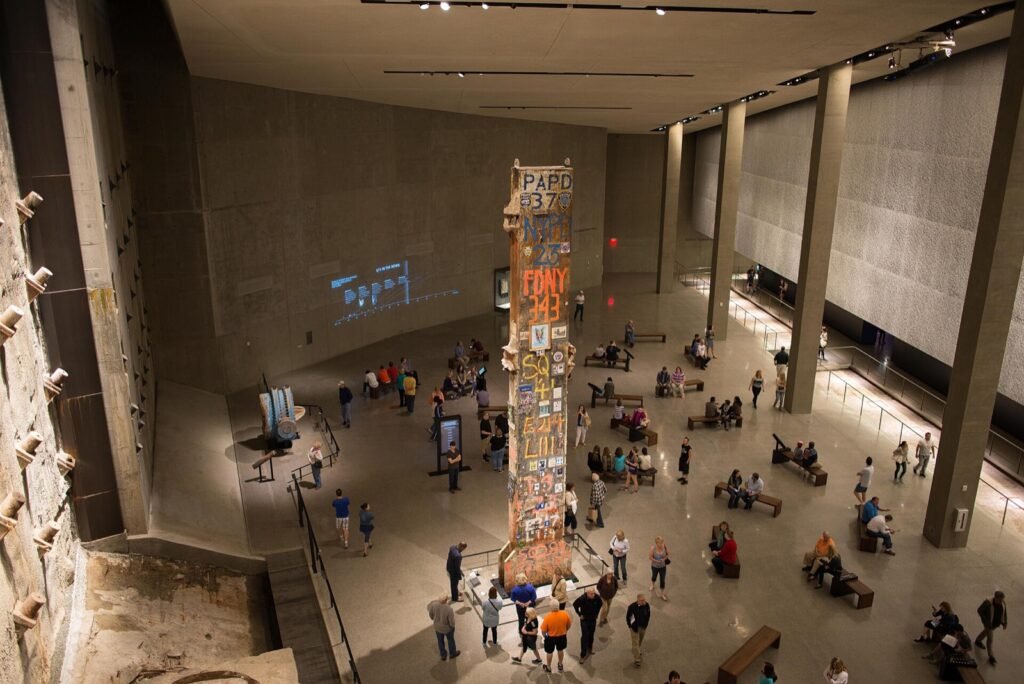
The Last Column
One 36-foot steel column from the South Tower stayed standing to the end. It stood near where six missing members of Squad 41 were found, and a member of the squad painted “SQ 41” on it.
The column was cut down on May 28, 2002, at a private ceremony for the workers. On May 30, 2002, it was carried out of the site in a public ceremony that marked the formal end of the recovery. It now stands in the 9/11 Memorial Museum.
The illness that followed
Exposure to the dust and smoke at the site has made many of the people who worked there sick.
Among FDNY members
The department began a medical monitoring program for members who worked at the site, and it now runs one of the clinical centers of the federal World Trade Center Health Program. Nearly 16,000 FDNY rescue and recovery workers have been part of the FDNY program. The department’s 25-year health report, released on September 1, 2026, gives these figures for its members, as of September 2026:
- 10,562 certified for at least one physical condition, such as lower or upper respiratory disease or reflux disease
- 4,496 certified for at least one mental health condition
- 4,257 with a current cancer certification
The report found that 86 percent of World Trade Center responders diagnosed with cancer were alive five years later, against 63 percent of unexposed New York State residents with the same cancers.
The names on the wall
The World Trade Center Memorial Wall at FDNY headquarters, 9 MetroTech Center in Brooklyn, carries the names of members who died of illness tied to the rescue and recovery work. As of September 2025 the department said more than 400 members had died that way. It added 36 names on September 2, 2026.
In June 2026 the department unveiled a second wall facing the first. It honors 154 members who were already retired on September 11, came back to work at the site and later died of related illness.
Our own list, with a note on each member, is at FDNY post-9/11 illness deaths.
The Zadroga Act
The James Zadroga 9/11 Health and Compensation Act is named for a New York City police detective who worked at the site and died in 2006. The dates that matter:
- January 2, 2011: signed into law. It created the World Trade Center Health Program and reopened the September 11th Victim Compensation Fund.
- July 1, 2011: the health program opened.
- December 18, 2015: reauthorized. The health program was extended through 2090. The fund was extended for five years.
- July 29, 2019: the Never Forget the Heroes Act, named for James Zadroga, Ray Pfeifer and Luis Alvarez, extended the fund’s filing deadline to October 1, 2090, and funded it to pay all eligible claims. Ray Pfeifer was a New York City firefighter who died on May 28, 2017.
- February 3, 2026: a federal spending law tied the health program’s yearly funding to its enrollment.
The World Trade Center Health Program
The program is run by the National Institute for Occupational Safety and Health, part of the Centers for Disease Control and Prevention. It gives monitoring and treatment for certified World Trade Center conditions at no out-of-pocket cost to responders and survivors.
As of September 2026 the program’s quarterly summary, which it labels preliminary, showed 147,137 people enrolled. About 100,000 of them were certified for at least one condition. Over the life of the program 59,279 members have been certified for cancer.
The September 11th Victim Compensation Fund
The fund is run by the U.S. Department of Justice. It pays compensation for physical illness or death tied to the attacks or to the debris removal. A person does not have to be sick to register.
As of October 2026 the fund had received 114,415 claims and awarded $18.95 billion.
How the department changed
What the reviews found
The McKinsey review, done at the department’s request in 2002, and the 9/11 Commission came to much the same list. Portable radios did not carry reliably in a high-rise. One tactical channel could not hold that many units. Companies skipped staging. Chiefs in the lobbies had no reports from the police helicopters overhead. The recall had not been practiced. Most of the senior chiefs and nearly all the special operations units were in one place.
The Commission concluded that the radio failure was a contributing factor in the deaths in the North Tower, but not the main cause.
Radios
By 2004 the department had built a “post radio,” a repeater small enough for a battalion chief to carry up into a building to boost portable radio signals. Radio channels in use today are on our frequencies page.
Command and control
McKinsey recommended wider use of the Incident Command System, a full emergency operations center, incident management teams, a workable recall plan, written mutual aid agreements and staging at every third alarm or greater.
The department’s 2007-2008 strategic plan reports progress on each. Every fire and emergency medical member had been trained in the Incident Command System. A new Fire Department Operations Center could serve as a command post away from the scene and take video from police helicopters. An incident management team had been trained and certified. The recall had been automated so it could reach a single unit, battalion, division or rank. Mutual aid agreements had been signed with New York State and Nassau County.
In 2005 the city adopted the Citywide Incident Management System, which sets the roles and authority of each agency at an emergency. We explain it on our CIMS page.
Special operations and preparedness
On September 11 the department had one hazardous materials company, and it was at the Trade Center. The 2007-2008 plan describes a hazmat group of Hazmat 1 and 12 hazardous materials technician companies, with about 130 more fire and medical units trained for set jobs at a large incident. It also reports a new Center for Terrorism and Disaster Preparedness, two new 27-foot fireboats and harbor response training for 185 companies.
Memorials and where to pay respects
The FDNY Memorial Wall, Greenwich and Liberty Streets
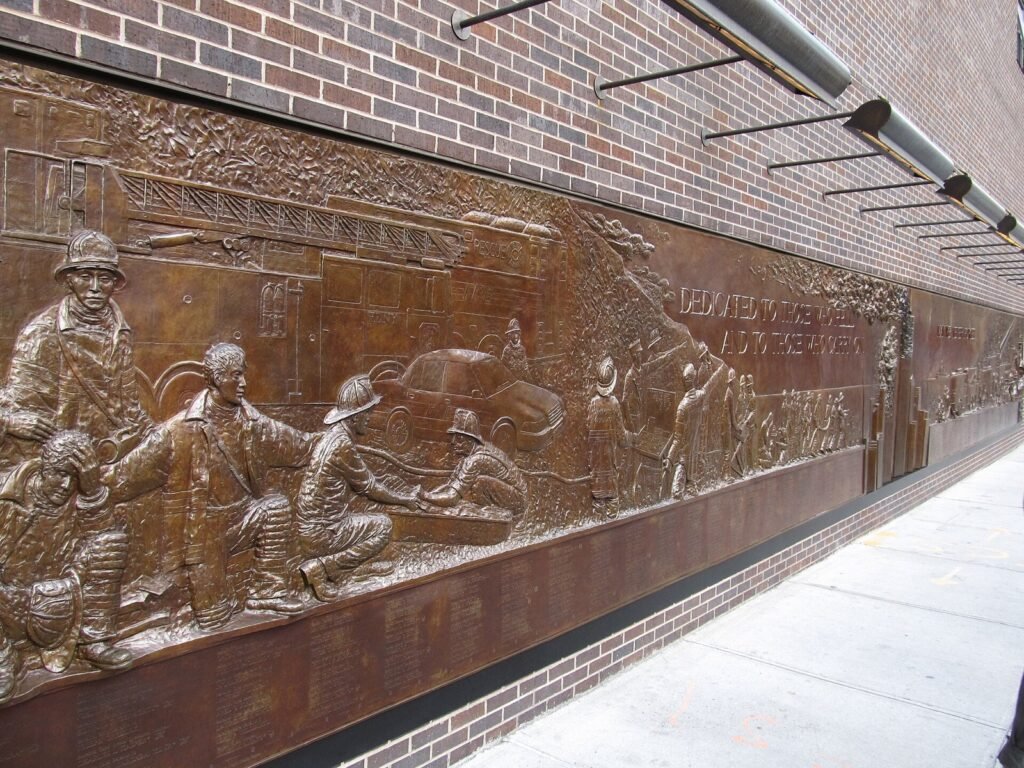
The wall is a bronze relief 56 feet long and six feet high on the Greenwich Street side of “Ten House,” the quarters of Engine 10 and Ladder 10 at 124 Liberty Street, across from the 9/11 Memorial. It was dedicated on June 10, 2006. It carries the names of the 343, each with rank and unit, under the words “Dedicated to those who fell and to those who carry on.”
The 9/11 Memorial and Museum
The Memorial fills about half of the 16-acre Trade Center site at 180 Greenwich Street. Two pools sit where the towers stood, and the names of the dead are cut into bronze panels around them. It opened on the tenth anniversary in 2011. The members of the department are grouped by company on the South Pool.
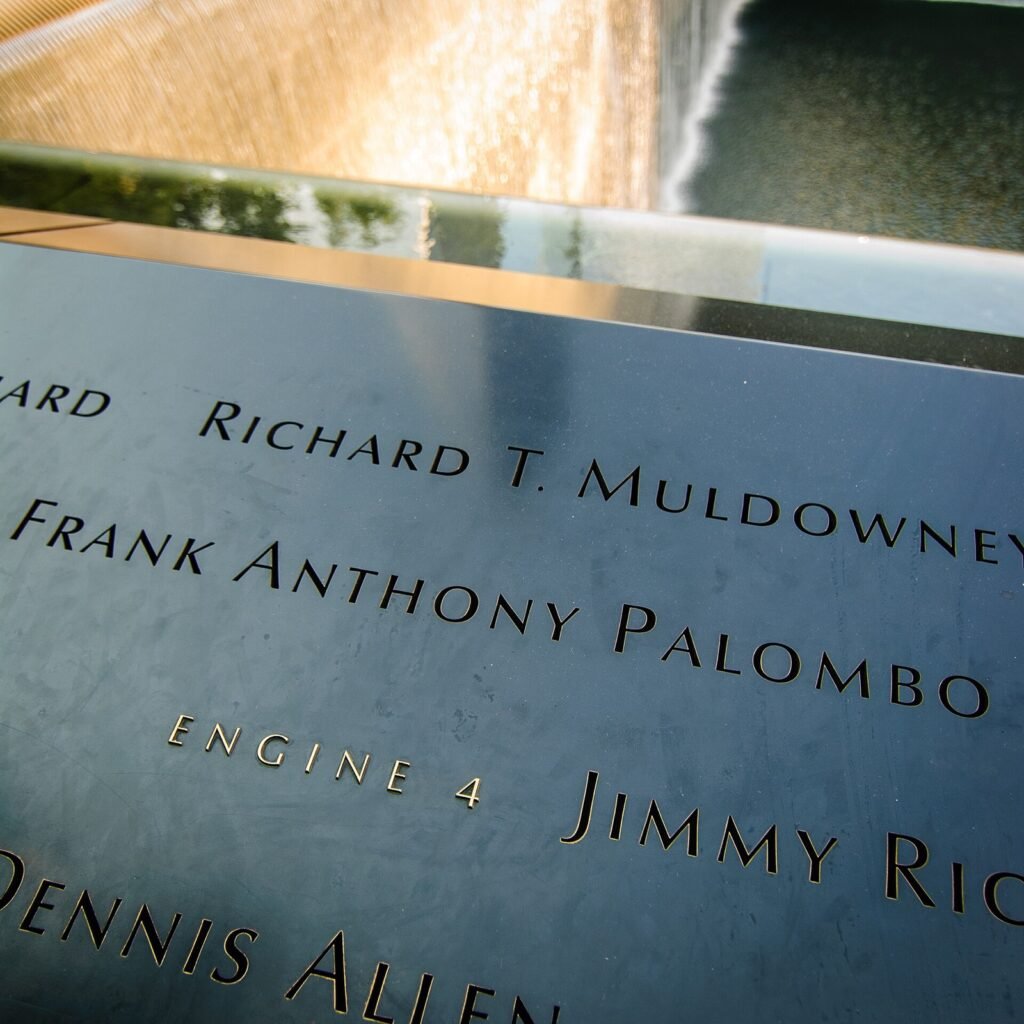
The Memorial Glade, dedicated on May 30, 2019, honors the rescue and recovery workers and everyone who is sick or has died from exposure at the site.
The Museum is at bedrock, seven stories below the plaza. The Last Column stands in its Foundation Hall, and the Ladder 3 rig recovered from the site is in its collection. Admission is free for rescue and recovery workers.
The New York City Fire Museum
The museum houses a memorial to the 343, built in 2002 and described by the department as the first permanent tribute to them.
Each year
- September 11, the reading of the names. Family members read the names aloud at the 9/11 Memorial.
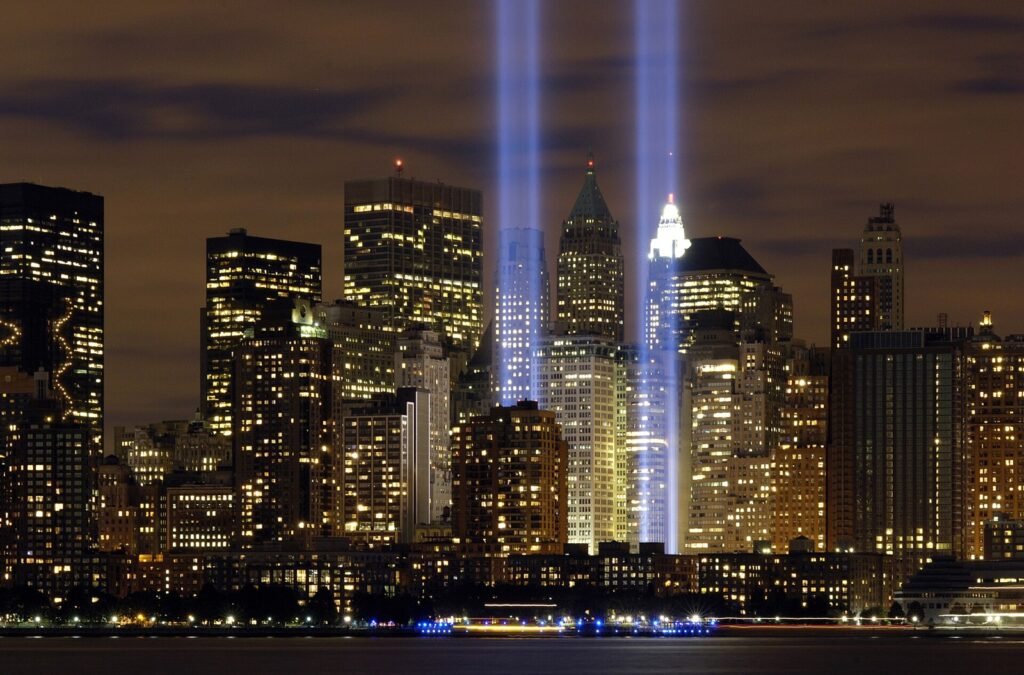
- September 11, Tribute in Light. Two beams made by 88 xenon lights shine from dusk to dawn from the roof of the Battery Parking Garage, south of the Memorial.
- September, FDNY services. The department holds a World Trade Center memorial service for families, a service at headquarters, a wreath laying at the Fire Museum and the dedication of new plaques on the wall at headquarters.
- May 30. A ceremony at the 9/11 Memorial marks the end of the recovery and honors those who are sick or have died.
Runs and stair climbs
- Tunnel to Towers 5K Run and Walk, New York City. Held on the last Sunday of September since 2002. The foundation’s site tells how Firefighter Stephen Siller of Squad 1 went through the Brooklyn-Battery Tunnel on foot with his gear on his back.
- Tunnel to Towers Tower Climb NYC. A climb of 104 stories at One World Trade Center.
- 9/11 Memorial Stair Climbs. Organized through the National Fallen Firefighters Foundation. Each climber goes up the equivalent of 110 stories for one of the 343.
Resources and foundations
Health and compensation (official)
- World Trade Center Health Program. The federal program that monitors and treats certified 9/11 conditions for responders and survivors, at no out-of-pocket cost.
- September 11th Victim Compensation Fund. The federal fund that pays compensation for physical illness or death tied to the attacks and the cleanup.
- NYC 9/11 Health. The city Health Department’s World Trade Center Health Registry, which tracks the health of people exposed and points them toward care.
FDNY and union support
- FDNY Foundation. The official nonprofit of the department. It pays for training, equipment and public fire safety work.
- Uniformed Firefighters Association. The firefighters’ union. It runs a benefit fund for members and keeps a page for members lost to World Trade Center illness.
- Uniformed Fire Officers Association. The fire officers’ union. Its site carries the Bravest Scholarship Fund for children of members who died while active.
- FDNY Fire Family Transport Foundation. Volunteers who drive members and their families to and from medical care, at no charge.
Foundations and charities
- Tunnel to Towers Foundation. Provides mortgage-free homes to families of fallen first responders and service members, and adapted homes for those badly injured.
- FealGood Foundation. Assists emergency personnel and other workers injured on the job, and speaks up for 9/11 responders and survivors.
- Ray Pfeifer Foundation. Helps 9/11 first responders with medical needs that insurance does not cover.
- Friends of Firefighters. Free, confidential counseling and wellness services for active and retired FDNY firefighters and their families.
- Leary Firefighters Foundation. Funds training facilities, vehicles and equipment for fire departments.
- Terry Farrell Firefighters Fund. A volunteer-run fund, started after September 11, that supports firefighters and their families and passes donated rigs and equipment to departments.
- Answer the Call. Financial help and lasting support for families of New York City firefighters, police officers, Port Authority police and EMS members killed in the line of duty.
- Silver Shield Foundation. Helps pay for the education of children of fallen firefighters, EMS members and police officers.
- National Fallen Firefighters Foundation. Honors firefighters who died in the line of duty across the country and supports their families.
- VOICES Center for Resilience. Long-term support and mental health resources for 9/11 families, responders and survivors, including families of those lost to illness.
- 9/11 Day. Organizes the September 11 National Day of Service and Remembrance.
Memorials and museums
- 9/11 Memorial and Museum. The memorial and museum at the World Trade Center site.
- New York City Fire Museum. The museum of the city’s fire service, with its memorial to the 343.
A listing here is not an endorsement.
More from Fire Wire
- Statistics from 9/11
- Mysterious man in red bandana, the story of Welles Crowther
- The never ending disaster, 15 years later
- Deaths from 9/11 diseases will soon outnumber those lost on that fateful day
- To America, Love Russia, the Tear Drop Memorial in Bayonne
- FDNY post-9/11 illness deaths: the full list
Questions and answers
How many FDNY members died on September 11, 2001?
343. That includes the Chief of Department, the First Deputy Commissioner, the department chaplain, a fire marshal and two paramedics.
What time did the towers collapse?
The South Tower collapsed at 9:59 a.m., 56 minutes after it was hit. The North Tower collapsed at 10:28 a.m., 102 minutes after it was hit. 7 World Trade Center collapsed at 5:20 p.m.
Did firefighters in the North Tower hear the order to evacuate?
Many did and some did not. The 9/11 Commission found that at least 24 of the 32 companies sent into the North Tower got the order, by radio or by word of mouth. Radios worked poorly in the high-rise, the channel was overloaded, and some off-duty members had no radio.
How many FDNY members have died of 9/11-related illness?
More than 400, as of September 2025, according to the department. It added 36 names to its World Trade Center Memorial Wall in September 2026.
Where is the FDNY Memorial Wall?
On the Greenwich Street side of the Engine 10 and Ladder 10 firehouse at 124 Liberty Street in lower Manhattan, across from the 9/11 Memorial. A separate wall for members lost to World Trade Center illness is at FDNY headquarters in Brooklyn.
Sources for this page. Last reviewed: November 2026. See something that is wrong or out of date? Send a tip.